.png)
Hypersomnia Self-Assessment Quiz: Understanding Excessive Daytime Sleepiness
Read More


If you are experiencing symptoms of sleep apnea, such as loud snoring, chronic fatigue, or waking up gasping for air, you are likely wondering about the next steps. Fortunately, modern medicine offers a convenient and clinically accurate solution: the at-home sleep test (HST). For many Texans, the primary question isn't about the test's effectiveness, but rather its cost, especially when utilizing health insurance.
Dealing with insurance requirements can be confusing, but knowing what to expect financially puts you in control of your care. This guide provides a clear overview of the costs associated with an at-home sleep test in Texas. It breaks down the expenses so you can pursue a diagnosis with confidence. At Frontier Sleep & Wellness, we believe in making sleep medicine accessible by keeping our pricing and processes transparent.
Before looking at insurance specifics, it helps to know the baseline cost of at-home sleep tests. Their affordability and convenience make them a preferred first-line diagnostic tool for many physicians and patients across Texas.
When considering your options, looking at the full financial picture is essential. You can find a detailed breakdown on our cost comparison page.
The most significant financial advantage of an at-home sleep test is its price compared to traditional polysomnography (in-lab study).
This dramatic difference comes from eliminating facility fees and overnight staffing costs, making the HST a streamlined, financially prudent choice.
For residents of the Lone Star State, pricing is competitive. Without insurance, the cash price for a home sleep study in Texas generally falls between $189 and $400. This localized cost efficiency makes diagnosing sleep apnea accessible, allowing you to get answers without the heavy price tag of a hospital stay.
The good news for patients in Texas is that most major health insurance plans generally cover at-home sleep tests. Insurers often prefer HSTs as the first step for suspected Obstructive Sleep Apnea (OSA) because they are more cost-effective than in-lab alternatives.
While your insurance may "cover" the test, your actual out-of-pocket expense depends on your plan's structure:
Insurance providers will typically only cover a sleep study if it is deemed medically necessary. To establish this, your physician must document symptoms such as snoring, witnessed pauses in breathing, or excessive daytime sleepiness. If you are unsure whether your symptoms warrant a test, taking a Sleep Quiz is a helpful first step before consulting a provider.

To avoid surprise bills, you must navigate two critical steps: pre-authorization and benefits verification. These processes ensure that your provider and insurer are aligned on your coverage before you incur any costs.
Pre-authorization (or prior authorization) is a formal approval process where your insurer confirms a service is medically necessary before you receive it. Many providers mandate this for sleep studies. While some have waived this for home tests to encourage lower-cost diagnostics, others strictly enforce it.
If you skip this step when it is required, your insurance company may deny the claim entirely. This would leave you responsible for the full cost of the test. Therefore, confirming this requirement is a vital protective measure for your wallet.
At Frontier Sleep & Wellness, we prioritize transparency. We encourage all patients to verify your benefits with us to understand your financial responsibility upfront. Our team performs a detailed insurance check on your behalf.
We look at your specific plan coverage for at-home sleep tests, your current deductible status, and any estimated copay. This proactive approach eliminates guesswork and provides you with a clear financial picture before you commit to the test.
A smart strategy to manage out-of-pocket expenses is using a Health Savings Account (HSA) or Flexible Spending Account (FSA). Healthcare.gov notes that funds in these accounts can generally be used for qualified medical expenses. Since sleep disorder diagnostics are qualified medical expenses, you can use these funds to cover deductibles or copays associated with your sleep test.
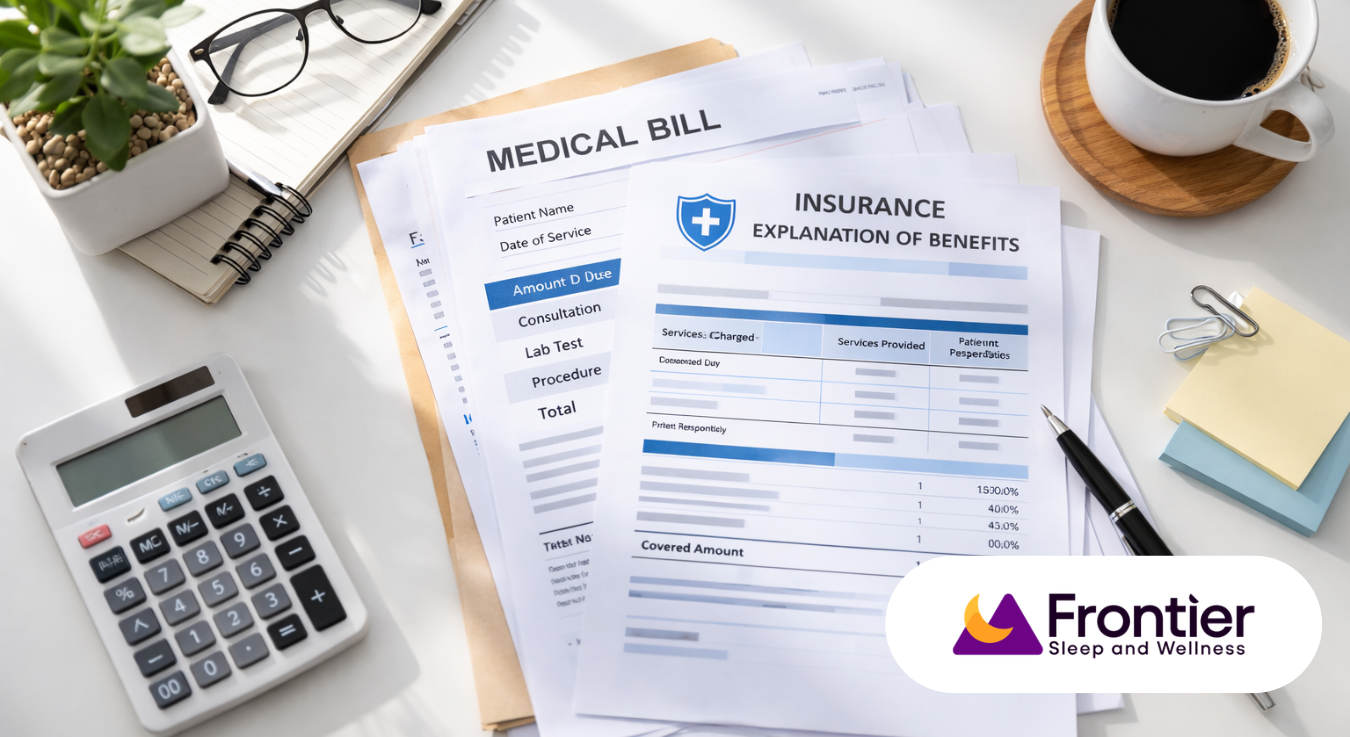
Getting a clear diagnosis is the starting point for effective treatment. Once diagnosed, insurance coverage typically extends to the recommended therapy. At Frontier Sleep & Wellness, we believe in providing options rather than locking you into a single path.
We provide information on various treatment options so you can make an informed choice. Whether your therapy involves a CPAP machine or a custom oral appliance, verifying your specific benefits for durable medical equipment (DME) is the next crucial step in your journey.
The cost of an at-home sleep test shouldn't be a mystery. By knowing the key insurance terms and verifying your benefits, you can move forward with clarity.
We are committed to providing medical-grade diagnostics and empowering you with a clear understanding of your financial responsibilities. If you are ready to move forward or have specific questions about your coverage, contact us today.
How much does an at-home sleep test typically cost with insurance?
The out-of-pocket cost for an at-home sleep test with insurance varies significantly based on your specific plan's deductible, copay, and co-insurance. While the cash price for an at-home sleep test can range from $150 to $1,000, and $189 to $400 in Texas, your insurance may cover a substantial portion if deemed medically necessary. It's crucial to verify your individual benefits.
Does my health insurance cover home sleep studies for sleep apnea?
Most health insurance plans, including Medicare and Medicaid, typically cover at-home sleep studies when they are prescribed by a doctor and considered medically necessary for diagnosing sleep apnea. However, coverage details, including potential prior authorization requirements, depend on your specific policy.
What factors affect my out-of-pocket cost for a home sleep test?
Several factors influence your out-of-pocket cost, including whether you've met your annual deductible, your plan's copay amount, any co-insurance percentage you're responsible for, and if the provider is in-network. Pre-authorization requirements from your insurer can also impact coverage.
Can I use my HSA or FSA to pay for an at-home sleep test?
Yes, in most cases, at-home sleep tests and associated sleep apnea diagnosis and treatment expenses are eligible for reimbursement through Flexible Spending Accounts (FSA) and Health Savings Accounts (HSA). We recommend confirming with your plan administrator for specific details.
Do I need pre-authorization from my insurance for a home sleep test?
Many insurers require pre-authorization before they will cover a sleep study, meaning your doctor must submit a request explaining its medical necessity. However, some insurance providers have removed this requirement for home sleep apnea tests. It's always best to verify with your insurance provider.